
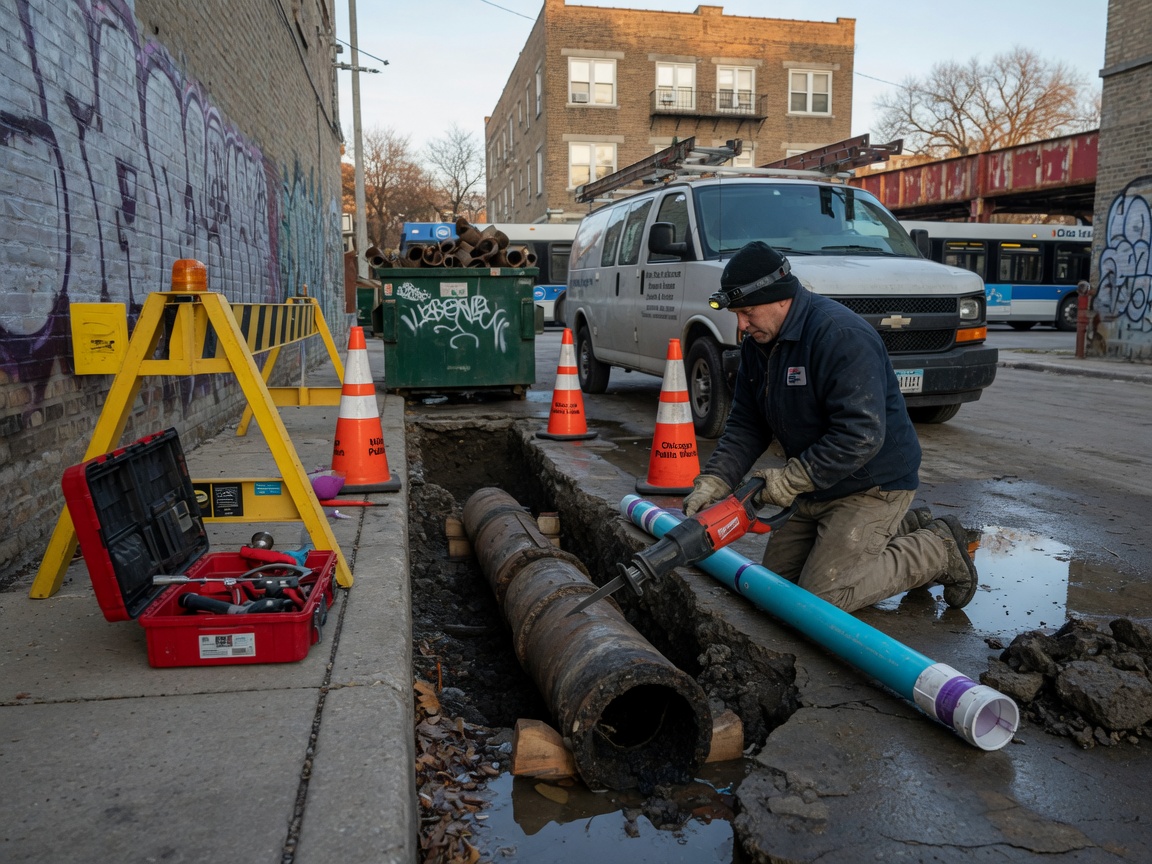
Chicago's older housing stock in neighborhoods like Lincoln Park, Hyde Park, and Logan Square often features galvanized steel or cast iron lines installed decades ago. These materials corrode from within, especially where soil shifts along the Chicago River or where roots from mature trees in Grant Park areas intrude. Cold winters in the humid continental climate frequently cause contraction cracks that only appear once temperatures rise again.
Slab leaks under concrete foundations in South Loop and West Loop buildings require breaking through floors or using trenchless methods to avoid disrupting historic brickwork. Copper and PEX transitions must meet Cook County code for pressure ratings and backflow prevention. Technicians carry both materials on trucks because mixing old and new lines without dielectric unions leads to rapid failure.
Evanston and Oak Park homes share the same aging infrastructure challenges as Chicago proper, with many properties still on original sewer laterals that crack under freeze-thaw cycles. Access is often limited in narrow gangways or finished basements common throughout Uptown and Andersonville. Proper isolation of the water main at the street valve prevents flooding neighboring units during repairs.
Winter calls spike when pipes in unheated spaces near exterior walls freeze, particularly in Bridgeport and Pilsen two-flats. Technicians thaw lines with controlled heat before replacing sections to avoid further splitting. Every job includes a camera inspection of the affected run to identify additional weak points before walls are closed.
Technician insight
In Chicago the thing that catches most people out with Pipe Repair & Replacement is how quickly galvanized lines in 1920s–1950s two-flats fail once one leak starts. Cold winters expand the problem because the same pipes that survived summer now split when water expands in uninsulated exterior walls common in Lincoln Park and Lakeview. Always check the full run rather than patching the obvious spot.
Burst Line in Logan Square Two-Flat
A cold snap caused a galvanized supply line to split behind a finished basement wall. Camera inspection revealed multiple pinholes along the remaining run. The section was replaced with PEX using existing access points, restoring service without opening additional walls.
Pipe Repair & Replacement Services We Offer
✓Cast Iron Pipe Replacement
Full or sectional replacement of corroded cast iron stacks and laterals common in pre-1970 Chicago homes using no-dig methods where possible.
✓Copper Pipe Repair
Soldered or press-fit repairs on copper supply lines, including dielectric unions to prevent galvanic corrosion in mixed-metal systems.
✓Slab Leak Detection and Repair
Electronic and camera location of leaks under concrete slabs followed by epoxy lining or rerouting to minimize floor demolition.
✓Frozen Pipe Thawing and Replacement
Safe thawing of ice-blocked lines in exterior walls and attics followed by replacement of split sections before refreezing occurs.
✓PEX Repiping
Conversion of galvanized or copper systems to PEX tubing in accessible areas of older Lincoln Park and Wicker Park residences for improved flow and freeze resistance.
✓Sewer Line Spot Repair
Targeted excavation or lining of damaged clay or cast iron sewer laterals serving single-family homes in Rogers Park and Andersonville.
Pipe Repair & Replacement Cost in Chicago, IL
| Service | Typical Range | What Affects It |
|---|---|---|
| Copper Pipe Repair | $250–$650 | Varies with wall access and length of run |
| Cast Iron Section Replacement | $400–$900 | Higher in multi-story buildings with limited access |
| Slab Leak Reroute | $800–$1800 | Depends on concrete thickness and finish restoration |
| Frozen Pipe Replacement | $300–$700 | Includes thawing and any drywall repair |
| PEX Repipe (Partial) | $600–$1500 | Based on number of fixtures and wall demolition required |
Ranges are typical for Chicago, IL and confirmed with an exact written quote before any work starts.
How it works
- 1
Initial Assessment
Technician arrives within the hour, shuts off water if active leak, and performs camera or pressure test to locate the failure.
- 2
Material And Access Planning
Selects repair method based on pipe age, location, and neighborhood access constraints such as narrow gangways in West Loop buildings.
- 3
Repair Or Replacement
Performs targeted fix or full run replacement using code-compliant materials while protecting finished surfaces.
- 4
Testing And Restoration
Pressure tests the line, restores access points, and confirms no leaks remain before leaving the site.
Pricing
Upfront quotes provided before any work begins; final price depends on access difficulty and material type.