
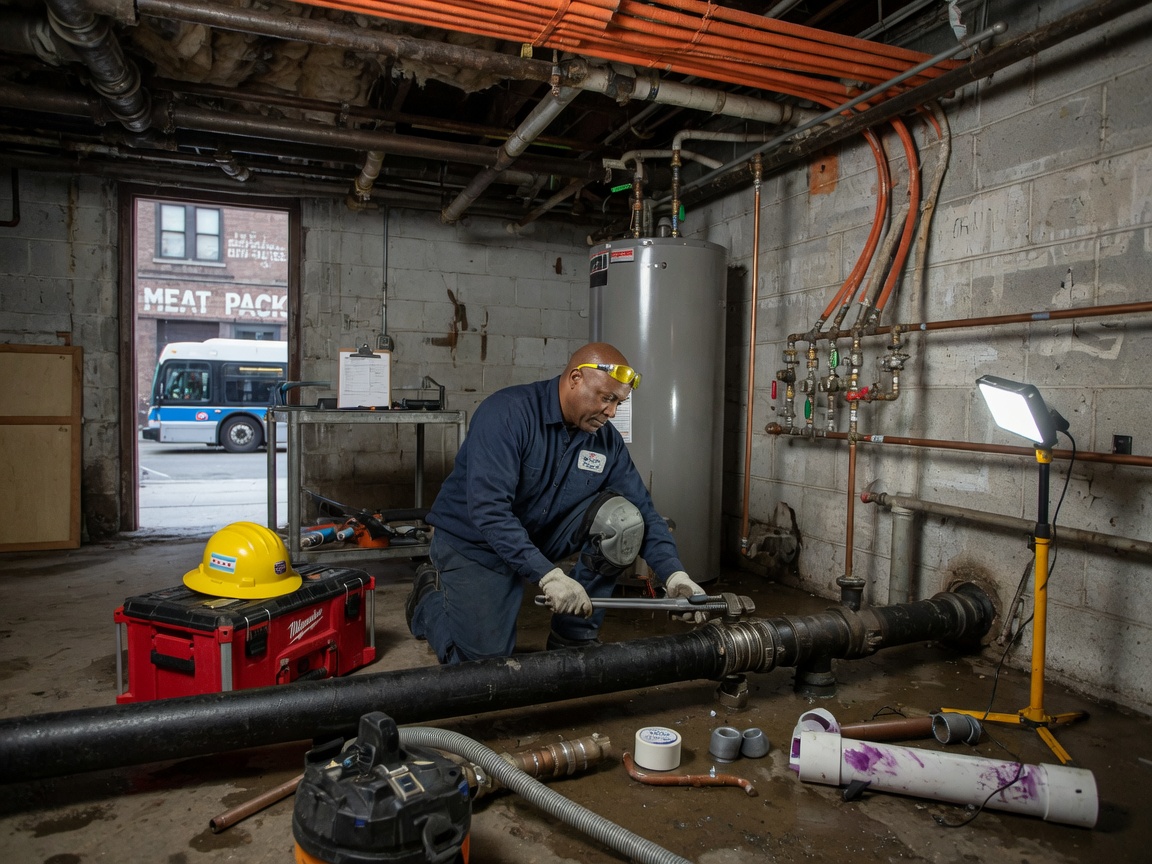
Chicago commercial buildings in neighborhoods like Wicker Park and Lincoln Park often feature aging cast iron stacks and galvanized lines installed decades ago that corrode faster under the city’s humid continental swings. Hot summers increase condensation inside uninsulated lines while deep winter freezes push water pressure spikes that crack joints in unheated basements common to West Loop warehouses. Technicians must account for Cook County code requirements on backflow prevention when replacing sections near the Chicago Riverwalk or Soldier Field district, where older mains run closer to grade and soil movement adds stress.
Restaurants and retail spaces in Logan Square and Uptown frequently deal with grease and food solids that combine with cold-weather contraction to create stubborn blockages downstream of traps. Commercial plumbers here carry jetting equipment sized for four-inch lines and camera systems to trace problems without tearing up tile floors in historic Andersonville storefronts. Water quality from Lake Michigan sources also accelerates mineral scaling on commercial water heaters, requiring descaling rods and acid flushing that residential crews rarely carry.
When a high-rise in the South Loop or Bridgeport reports low pressure on upper floors, the issue often traces to shared risers that run through unconditioned stairwells. Technicians isolate sections floor by floor rather than shutting entire buildings, especially during winter when a full drain-down risks frozen laterals in nearby Evanston and Oak Park properties. Every job includes a written scope that notes existing material types so future crews know whether they are tying into copper, PEX or remaining galvanized runs.
Technician insight
In Chicago the thing that catches most people out with commercial plumbing is the mix of 1920s cast iron stacks and 1950s galvanized laterals that run under unheated sidewalks in neighborhoods like Wicker Park and Bridgeport. Once winter temperatures drop, contraction plus heavy restaurant grease turns a slow drain into a full backup overnight, and the repair always takes longer because you have to isolate the shared riser without shutting the whole block.
Wicker Park Restaurant Backup
A Wicker Park café reported wastewater backing up through floor drains during a cold snap. Camera inspection showed a partial collapse in the four-inch cast iron line under the unheated basement. The crew isolated the section, replaced twelve feet with no-hub pipe, and restored service before lunch service without excavating the sidewalk.
Commercial Plumbing Services We Offer
✓Commercial Drain Cleaning
High-pressure jetting and camera inspection for restaurant and retail lines that accumulate grease and debris faster in Chicago winters.
✓Backflow Prevention Testing
Annual certification and repair of testable assemblies required by Cook County health codes for businesses near the Chicago Riverwalk.
✓Commercial Water Heater Repair
Tank and tankless troubleshooting including descaling for units serving multiple fixtures in older Lincoln Park and Hyde Park buildings.
✓Grease Trap Maintenance
Scheduled pumping and baffle inspection to keep kitchens in Wicker Park and Logan Square compliant during peak summer traffic.
✓Pipe Repair and Replacement
Trenchless and traditional methods for cast iron and galvanized lines common in West Loop and South Loop commercial stock.
✓Fixture Installation for Businesses
ADA-compliant sinks, toilets and service sinks installed with proper venting for new or renovated spaces in Uptown and Andersonville.
Commercial Plumbing Cost in Chicago, IL
| Service | Typical Range | What Affects It |
|---|---|---|
| Commercial Drain Cleaning | $275–$650 | Depends on line size, access and severity of grease or root intrusion. |
| Backflow Prevention Test | $125–$225 | Includes certification paperwork; repairs billed separately. |
| Grease Trap Pumping | $300–$550 | Frequency and trap size affect final cost. |
| Pipe Section Replacement | $450–$1,200 | Varies by material, depth and whether trenchless methods apply. |
Ranges are typical for Chicago, IL and confirmed with an exact written quote before any work starts.
How it works
- 1
Call Intake
Dispatcher gathers address, symptoms and access details while confirming 24/7 response for the reported neighborhood.
- 2
On-Site Assessment
Technician inspects the system, locates shutoffs and notes building age and pipe materials before quoting.
- 3
Repair Execution
Work proceeds with minimal disruption to business hours, using containment and floor protection suited to commercial interiors.
- 4
Final Testing
Lines are pressurized, cameras re-run if needed, and the site is left clean with written documentation.
Pricing
Upfront written quotes provided on site before any repair work starts.